
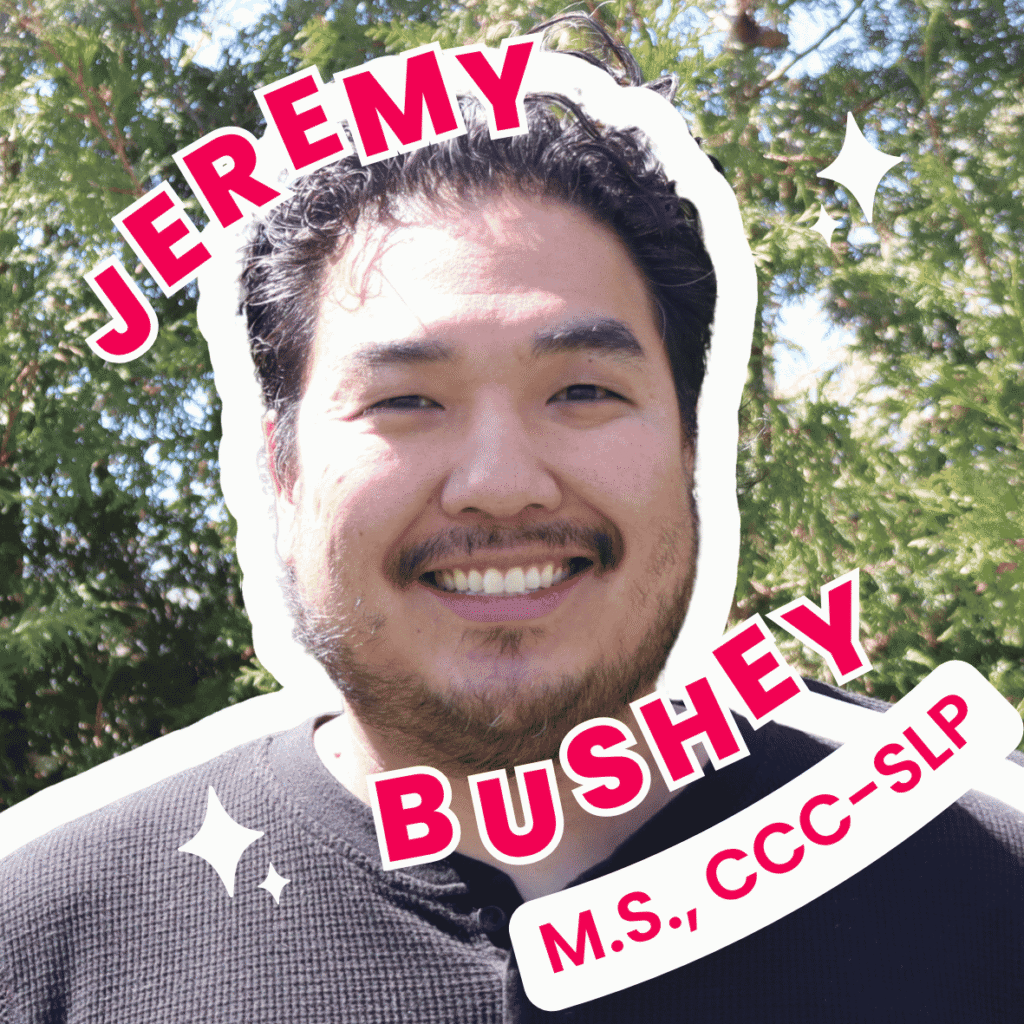
We’re finishing our conversation with Jeremy Bushey, M.S., CCC-SLP. You’ve previously read how needing support with speech and language skills can impact a child’s readiness to join preschool or kindergarten and how Speech Therapy differs across settings like school or a clinic like ACP’s. Now, Jeremy addresses parents, teachers, and society more directly and provides further details that might indicate a child is ready for school or would benefit from additional intervention.
When you’re finished, be sure to read how Occupational Therapy impacts school readiness in our article with Dr. Salvatore.
Does your work influence a child’s readiness for preschool or kindergarten, and if so, how?
Yes, 100%. The learners either come before preschool or are coming from a preschool and then transitioning to kindergarten. When I think of what a day looks like for kindergarten … You show up. You get to class. It could be 10 to 20 kids, and there is a teacher-led plan. Granted, I think schools are improving their understanding of UDL, or Universal Design for Learning, like how can we make learning accessible for everybody and provide accommodations? I think schools are doing a great job of transitioning in that area.
But in terms of what I talked about where some of our learners are in communication … If a kiddo who doesn’t really have an effective way to protest or refuse or say no, they can be seen as pretty compliant, right? They’re just flexible. They kind of go along. They don’t refuse. There’s no big outward behavior. They just kind of are there.
That’s not really in that learner’s best interest.
They could easily get lost in the shuffle, because in the school, there’s more kids. But also communicating you need help or you need to go to the bathroom or you are hungry … Those requests are important to be able to have had at least some exposure with—whether that’s through speech, through visuals, or through gestures and prompts. Just having that information that can be passed on to the teaching team is definitely really beneficial.
The same goes for following directions and that receptive language. When the teachers are addressing the class maybe having visuals step-by-step, like to help line up for lunch … Some of those directions and routine directions are really important for success in the classroom.
There’s a lot of listening that has to happen and a lot of sometimes sitting around. And as we know, a lot of our kiddos have the need to seek some sort of sensory or motor input or output throughout their day to help regulate and keep their focus and regulatory state.
I wasn’t really familiar with clinics like ACP before, so coming from a school to here, I see now a lot of the groundwork that’s important for a child if school is the goal for after services with ACP. I’ve also seen what happens when some skills aren’t targeted yet or they haven’t had exposure to some of this work before.
Having to work on some of these foundational communication skills while being in kindergarten, where the schools may not have the resources or the staff or personnel that support development in those skill areas … The child is probably missing information. Average kindergarten lessons that they should be learning, they might not be getting.
So 100%, we prepare kids for school. One of my kids is going to head to kindergarten so I know they spend a lot of time the first half of the year working on how do we follow the routines and the expectations of being in a classroom. And for someone who has Autism and language is tough … You’re five years old, and you don’t really have an effective way to communicate.
That can be pretty tough entering that kind of space. Clinics like ACP really set kids up by working on these skills, transitions, and visuals.
What should a caregiver of a young child with Autism with speech differences know about their child’s future?
Every learner is unique and will have their strengths and their areas of need and support. But along the way, there are people out there who can help you with that and figuring out what those strengths are and what some of those areas of need are. As a caregiver, it’s more than likely they know, right? We always say the caregivers know their child the best.
You may know your child has these strengths and these areas of need, but then what do you do with that?
There’s a lot of resources, and it’s okay to not know and ask for help, because it is overwhelming. You’re a parent, an advocate, and that’s a lot to handle. There’s a lot of new studies and resources out there that you can implement at home too, to help with those language and communication pieces.
I know there is concern with Speech Generating Devices and a thought they may hinder their kid’s ability to develop speech. There’s no evidence that supports that claim.
It won’t impact their acquisition of speech if that is something that will happen for them. But in the moment, as they progress as learners and communicators, supporting their current stage so they can communicate their wants and needs is always the thing to focus on. There’s so much out there now with technology.
It’ll be okay. It’s not going to be easy, but knowing and embracing the team approach across ACP and school-based teams … There’s Special Education teams when they get to school. There’s a lot of people to seek support from.
When in doubt, language is great. Just narrate everything you do. For some—depending on what age we are—we’re not sure really what they’re taking in until they’re not expressing it, right? Because if they’re not, if expressive language is difficult, we may not be sure what they are understanding or capable of. But we have seen receptive language could be higher and they do understand a lot, but just don’t communicate a lot.
We always say, Narrate everything you do. Nightly routines, books, talk about things in their environment … Label, routine, predictability …
What sort of things should a preschool or primary teacher know or prepare for when a child with communication differences is joining their classroom?
Read. There’s reports and current goals and information on that incoming student from a clinic like ACP that we’re sending. Definitely read those and be familiar with their current mode of communication and what it may look like or what it may not look like. Familiarize yourselves—if not already—with the personnel in the district, the SLP, the OT, if there’s a BCBA … Those specialty service providers will be involved, as well. Communication within a team is going to be really beneficial to help that general educator have the resources they need.
We’re not expecting them to be an SLP and an OT and a BCBA. You’re the classroom teacher. Your job is to educate, and you have a whole class to attend to, but if you can set up your classroom in certain ways, like the visuals we discussed, it’s very helpful. That’s not probably a really radical answer for an article, but! [Smiles]
Communicating with the past team and the current team is going to be very helpful. Getting an idea the first couple of weeks of school … It’s important to read the incoming information, but really trying to spend time with that kid to figure out interests and ways they communicate is going to be really helpful.
What more can our society do to help create a more equitable space for people with Autism who are a part of our larger community?
Education. Autism isn’t new. The way we can view it has changed a lot over the past decade. It’s not something that’s widely understood. I know a lot of people view Autism as like, Oh, it’s Autism. They don’t speak, right? That’s old school.
You see more and more adults being diagnosed with Autism who always felt like, Oh yeah. I always was rigid or had difficulty with this or socially I had difficulty with these settings. They are getting these diagnoses in adulthood and learning more about, Oh, okay, that now makes sense of why I had difficulties in these areas as a kid.
We think of the development in brains. I like the term that they’ve used, neurodivergent. It’s just not the typically developing brain and communication. Social pragmatics are the forefront of those big areas of need.
If you have those areas of need, that’s going to be how Autism predominately presents for you, but it’s really not that you lack those skills or anything. It’s just that you have a different way of developing those skills. And then for some, it’s a different way of using those skills.
The more we talk about it, the more we learn about it. The more we can understand and say, Oh, they just have a different way to communicate or a different way of navigating a setting. The more we learn about it, the better.
Is there anything else that you wanted to share that we haven’t already covered?
There’s an emphasis on Speech and Language, because … I get this a lot, not a lot of people know what we do. You’re just playing games with the kids? What are you working on? Are you working on articulation? Speech gets that emphasis and using speech to communicate when that’s just a piece. I really focus on the language. If speech happens to be their mode of communication, that is what it is. If it’s visuals, that’s where they are. There’s a whole spectrum of where they could be in terms of using visuals.
As Speech Therapists, we’re really focused on helping to create independent communicators, no matter what that looks like.
Children with communication challenges often benefit from a therapy like Speech to help provide a foundation of speech and language skills that allow them to better succeed in the academic setting. A child’s ability to transition to preschool or kindergarten is very individualized, based on that child’s unique strengths and areas for growth. Every child starts school with things to learn, however because the school-system was designed for neurotypical children, it’s critical to consider if your child is really ready when they have additional needs.
Many children with Autism easily transition to school, but some do not. Some children do therapy full time and start school later—which is completely okay! Some children do some school and some therapy instead of either full time—which is also totally okay! The underlying question is: does your child have the foundational skills they need to succeed in an academic setting? Like listening or self-advocacy skills Jeremy has shared. Or self-dressing or self-feeding skills, like Dr. Salvatore shared.
If you think your child is ready for school, that’s great! If you child has a diagnosis like Autism and meets other requirements for qualification, you can also explore implementing an IEP to help ensure your child’s continued success in a school setting. Explore the Individualized Education Plan here.
There’s a lot to consider when you’re weighing the pros and cons of starting school. We’re here to help provide an interdisciplinary perspective, thanks to compassionate, knowledgable clinicians like Jeremy. Stay tuned as we continue our back-to-school series by following us on all things social. Give us a call at 800-679-3609 or complete this form to inquire about services available near you! We can’t wait to help support you, and see the great things your child will accomplish!