
As we continue to think about whether a child is ready for preschool or kindergarten, ACP has the great privilege of connecting with interdisciplinary teams for a variety of informed perspective.
You’ve already heard from Dr. Salvatore who shared the physical skills required in a classroom, likes the ability to hang up your own backpack, use the potty independently, and open your own lunch to feed yourself. Or the attention skills like being able to focus and attend to classroom activities with multiple steps. If you want to catch up on that article, read it here.
There are also a variety of communication skills required for a preschool or kindergarten setting. Additionally, communication challenges are one of two symptoms of Autism that are present for every individual on the spectrum, making this a critical component when considering if your child is ready for school.
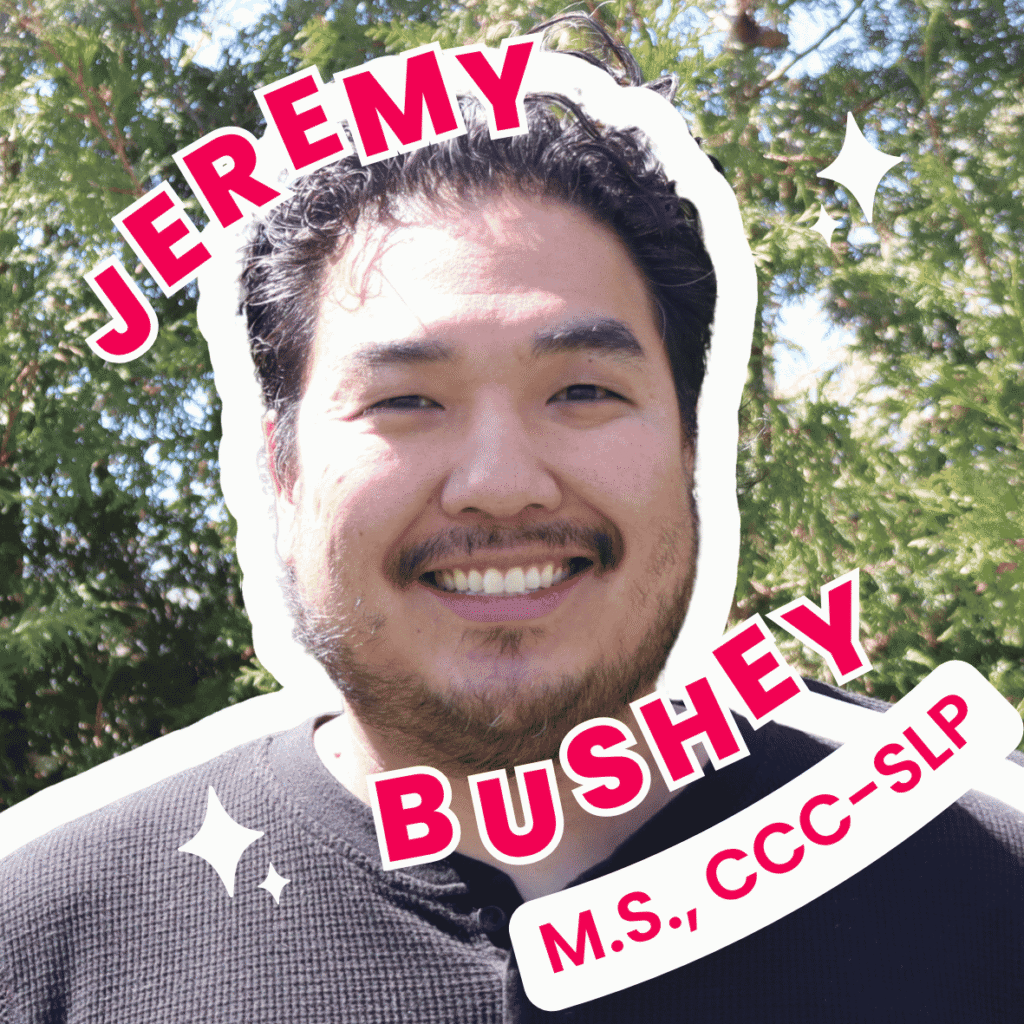
In part one of our conversation with Jeremy Bushey, M.S., CCC-SLP, we introduce some speech and language skills a child might need support in and the similarities and differences of addressing those skills in a school or clinic environment. Stay tuned for part two where Jeremy addresses parents, teachers, and society more directly and provides further details that might indicate a child is ready for school or would benefit from additional intervention.
Tell us about yourself.
My name is Jeremy. I’m and the SLP for the Vermont clinics in St. Albans and South Burlington. I grew up here in St. Albans. I went to undergrad at the University of Vermont where I found my love for communication and the field of Speech and Language. After graduation, I spent some time in the school districts working as an SLPA and learning more about the field before going to Emerson College in Boston to pursue my master’s degree. I haven’t looked back since. I was an SLP in the schools for six years before coming to ACP. Personally, I have two beautiful daughters and then three bonus daughters, ages 2, 4, 5, 6, and 8. So that’s always fun!
What are the main differences between working in the school system versus working in a center-based setting like ACP?
Working in schools is definitely really, really different. You have the IEP that we follow, and we write goals according to the levels in the IEP, but it’s really based on access to education and the student’s ability to access the curriculum and how it’s being presented in the classroom. That’s where that language piece really comes in …
Like expressive language—how are they able to express their ideas and their thinking to participate in these activities and curriculum-based requirements? Then receptive language—how can the student listen, process, understand directions, content, and all the modes that are being delivered?
It’s tied to that IEP. Up until this past year, for the schools I worked at least, we had to tie every strategy to like oral expression or listening comprehension.
Whereas here at ACP, which I really love, we can really just get at the heart of communication, functional communication. If the client has these strengths but needs support in these areas, whether that’s like social pragmatics and just gaining the attention of somebody or using either speech or some sort of device to express ideas.
Working in the clinic base, I feel like we can really get at functional, meaningful communication.
At the schools we have to tie it to accessing the classroom. Which makes sense. You’re in the school. This IEP is to help this student access the curriculum and access the material. That’s the heart of it. So it makes sense for the schools, but sometimes I feel like we have to get creative. As an SLP, I know there’s a need in this area, but this may be hard to focus on to relate it to the classroom.
And then, the resources are really different and the amount of routine and flexibility. At ACP, each kiddo has their own room. We have big, sensory rooms where we can come together and then step back when we need. In the school system, that’s not always an option, right? In the classroom, you don’t have really your own individual pod or room to move to do your work. You’re there with 10 to 15 kids and everyone follows the group plan.
Whereas the clinic at ACP, it’s more specific to the kid, a little more flexibility of, Okay, we’re not really going to be able to target this right now. But what else can we target? There’s some more flexibility with that.
Could you describe in a little more detail your role here at ACP? What kind of things are you doing to accomplish your goals and what are some things that you work on that are not just vocalizing words?
As the SLP, Speech-Language Pathologist, speech is the thing that gets the focus, right? You work on vocalizations or articulation. We ask, Is this communication—whether that’s speech vocalizations or communicative behaviors? How can we support these clients and where they’re at now in terms of how they communicate? And taking those next steps to becoming what we want, like independent communicators who communicate spontaneously without the need of prompts or just creating meaningful connections through communication. And, that looks different for every kid.
We kind of have to take a step back and look at what they’re currently doing, what are their motivators, and how do we gain their attention. That can be the hardest part, because if you have a kiddo who’s not really demonstrating much communication, and we don’t really know what their motivations are, it can be difficult to tell when it’s a true intent to communicate. I have to look at that and assess where they’re at—are they using a point or an eye gaze or a reach?
Those behaviors are all beautiful modes to communicate.
From there, what would the next step be? If they’re only kind of looking at an item, how can we maybe pair that gaze with a point or reach if they don’t have that yet? To figure out where the clients are for communication, we rely on observation, assessments, and reports from the BCBAs, the Behavior Techs, and the caregivers. And then we make goals to support those areas of need.
There are communication milestones we look at through observation and compare it to what the client is currently demonstrating in terms of communication. A child may have a certain skill, and they can communicate it using like a 2D photo. They can point to a photo to communicate, I want. At lunch they sit down, and they have their board of options, and they can communicate, I want chips, for that request. But maybe then the chips are presented and they can’t open them. Even though they can request the chips and direct someone to help open something, they’re not at that stage of using that level of communication.
They might give the chip bag without having a—we call it symbolic means to request for help.
You work with young children, most of whom have Autism. How does that influence your work compared to a different kind of Speech Therapy setting?
Some of the areas that we work on are seen at a higher frequency with kids who have Autism. And again, we have a range of communicators. Autism in itself is such a unique thing. A child with Autism learns language differently and they communicate a little differently, but the capabilities are still there. It’s just how can we figure out a way to problem solve and rely on your strengths? Where can we support those weaknesses for you to communicate? Versus some other areas … like working in the schools, I worked with students with articulation and phonological skills and acquiring sounds like S’s and T’s.
For me, I like working with someone to answer, How can we get you to engage in a communication that is enjoyable for you and you’re actually getting something out of it? I think is pretty, pretty special.
Working with this age group is special because they’re hitting these milestones and these developmental windows of opportunity where their brain is just taking in so much information. It’s kind of pushing them, because there’s no ceiling, right? We have a baseline—where the assessment is and evaluate where we’re at, but right now there’s really no ceiling for any of these kiddos, which is exciting. We are supporting these clients and their journey of becoming communicators, and we’re here to provide these supports and resources.
What is your ultimate goal as a Speech Therapist when you’re working with clients?
Every client and learner I get to work with, I want them to be an independent communicator who can communicate spontaneously and in their own way.
For requests, wants, and needs, but also comments socially and being engaged in something. Getting them to a level as close as we can to this independency. Like, what do you want for lunch? And then they can just choose or they can communicate something. That’s the goal I would love to have for every child, but if they can in some way just improve their ability and their understanding of communication, that’s a win in my book.
Whether your child is ready for preschool or kindergarten depends heavily on their individual strengths and challenges. For some children with Autism, the transition to school is easy with very limited interruption and acclimation to the change. For others, school can be quite staggering, especially if the child is not quite ready. Many children with Autism or communication challenges attend therapy full time or in addition to school to help them be more successful in the academic setting—which is perfectly fine!
Be sure to read part 2, where Jeremey addresses parents, teachers, and society more directly and provides further details that might indicate a child is ready for school or would benefit from additional intervention. If you need additional support talking through the options, connect with ACP at 800-679-3609 or complete this form to inquire about services available near you! You can meet all of Team Speech on our Speech Therapy page, as well!