
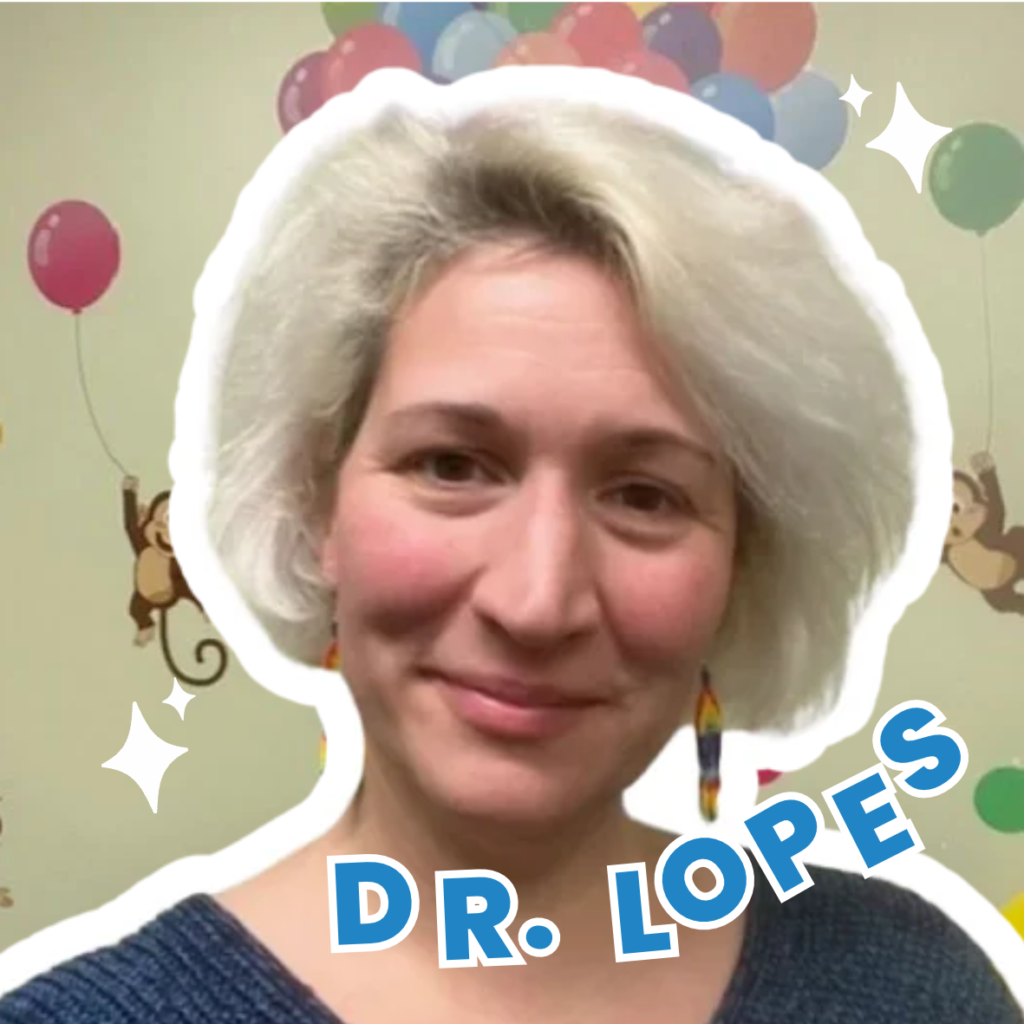
Meet Dr. Stephanie Lopes, a Licensed Clinical Psychologist who supports our Diagnostic Evaluation efforts in Massachusetts! Dr. Lopes is immensely passionate about her work and bridging the gap between diagnostics and support for families who need help during critical developmental periods in their child’s life.
In this article, Dr. Lopes details her diagnostic process and important information for every caregiver to know. After reading, if you have additional questions, reach out to Team ACP by completing our contact form. Our compassionate team is here to help!
Tell us about yourself.
I’m Dr. Stephanie Lopes. I am a Licensed Clinical Psychologist in Massachusetts. I have been working with Autism Care Partners to serve their population since 2023. I love what I do. I feel really good about bringing the care and information that is part of my diagnostic role to the clients we serve. I love bringing a lot of understanding and comfort to families at a time of unknowns.
In addition to being a Psychologist, I am also a mom of four kids—big age range. Oldest is 21, youngest is almost four years old, with a six- and a seven-year-old in between. I enjoy being a mom and wife and getting outdoors, walking on the bike path, hanging at the ocean. I love to do yoga when I have a chance to do it. It keeps me grounded, literally and figuratively. And, I’m aspiring to become a better ukulele player!
What ACP location do you currently support?
I specifically work out of the Fall River center. This center has undergone this amazing transformation. When I first started there three years ago, we were limited to a smaller group area and fewer individual rooms. Since the expansion, it’s become such a beautiful therapy center! The group areas are more expansive and interactive, and the sensory room is filled with every child’s dream toys! It’s a really lovely and welcoming place for the kids we serve.
It’s fun here! There’s one very large hallway that has all these beautiful decals that are alphabet and number oriented where the kids can jump and play and practice gross motor activities. And sure enough, every time someone comes in, the kids and I get to hop along on the flower petals and walk in a circle around the little spirals. It’s cool!
When you were little, what did you see yourself growing up to be as an adult?
I feel like this question hits something very deep inside of me, because I distinctly remember sitting with my grandmother at probably four years old, and she would ask me, Oh, honey, what do you want to do when you’re older? And I actually told her I wanted to be a doctor for people’s minds. I think this arose from there being a subliminal message in my household where it was like, We want you to go into medicine. My grandfather had been a pharmacist, but I found myself often deeply thinking about people and their emotional state and their thinking. That came very naturally to me, somehow.
Tell us about your career and the road that brought you to where you are right now.
When I was a teenager, I had thought about how much I loved natural medicine and had considered becoming a naturopathic physician, but I was not yet really sure what path I wanted to take. Because I wanted to somehow support myself through my early education, I became a massage therapist for a while and was deeply into yoga, meditation, and contemplative practice. I had a small business doing that for a while I was going through my undergraduate education.
As I progressed through college and saw all of the benefits that this practice was giving me, I ultimately decided I really wanted to take that further and get into psychology as a professional practice. There was space in psychology to use what I learned through yoga and meditation to help others with serious dysregulation. I continued through graduate study at William James College. Part of my internship ended up including learning and training with the ADOS, and it felt like a very natural transition to be looking for work that was in the field of developmental assessment.
What about ACP inspired you to join us?
I remember my interview with Dr. Rebeccah Costa, and I thought to myself, This lady speaks my language. I loved hearing that there was so much thought and care put into patient interaction. I actually have interviewed at other places where the people I interviewed with didn’t have positive regard for the people they were serving, and it really bothered me. I felt very at home when I talked with Dr. Costa. I felt like we understood each other and understood what we’re doing this work for. And that made a difference to me.
Can you tell us more about what the scope of your role entails?
At Autism Care Partners, I work as a Diagnostic Psychologist. I get the opportunity to conduct clinical interviews for patients that are typically with their caregivers, because the kiddos that are coming in for evaluation are very young, usually under 5. I talk with caregivers about what development has been like for their kids … since conception, really. What was pregnancy like? What was early development like? What have you observed about their language development and use? Were those milestones met or not met? Did they meet milestones and seem to regress? That history is really important to how we move forward with a case.
Testing itself in-person, or sometimes via telehealth for certain kiddos that qualify, looks a lot like playing actually. It’s kids interacting with bubbles and blocks and trucks and cars and dolls and Play-Doh, and it’s part of why I love doing what I do because it’s actually really fun. I get to play with kids. It’s one of the few places in psychology where it’s not necessarily characterized by more troubling thoughts and feelings. It’s a good time. And in that play—very significantly—we get to see what kind of strengths and weaknesses kids have developmentally, and what we can recommend going forward for the family.
What would surprise people about your role?
I find that caregivers are often surprised by the amount of information I am able to give them about what is known, but also what is not known specifically about Autism and other aspects of child development. I think the other thing that often ends up surprising is the flexibility that we offer in the evaluation process.
I’m a parent, too. Kids get sick. Kids will drool on themselves and sneeze all over you. It’s not a big deal. It’s just part of dealing with young ones. I really try to take the most supportive role for caregivers and let them know we’re doing this together. We try to make it not stressful. There’s plenty of stress in everybody’s life, but we can keep it flexible and still get the job done at the end of the day.
What does that day typically look like for families? How long does the process take?
On the shorter end, that process takes about maybe an hour. On the longer end of an in-person testing appointment, it might be an hour and a half. Families arrive at the center, and I have a room full of very enticing toys set up already. Kids walk in and usually … almost immediately … see an item of personal interest and want to touch and interact with it—like puzzles or blocks or cars.
Part of the testing process in-person also involves getting the caregivers involved. I’ll offer certain prompts like, Call your child’s name and see if they’ll turn to you. See if you can get them to play ball with you. See if we can get them to play peek-a-boo.
By the end of that hour to an hour and a half, we’ve got a lot of data that tells us what we need to do next. Then, caregivers are able to schedule a feedback meeting so we can go over that data via telehealth. They really only have to come in once. We keep it simple. There’s usually a telehealth clinical interview, the one in-person testing appointment, and then a follow-up meeting via telehealth.
You support families with very young children. What sort of things might tell a caregiver that a Diagnostic Assessment could be helpful for their child?
If children are not responding to you as you would expect them to at the age that they’re at. If you’re seeing that they’re often smiling at things instead of people. If your child is often struggling with sensory issues, and it seems really intense. If they’re very sensitive around their heads and don’t like to have their heads washed or get intensely dysregulated about getting their hair cut. And mind you, some of what would be considered common signs of Autism do crop up in the course of typical childhood development. I often will say to caregivers, It’s not the one thing or the two things that happen here or there. It’s if you’re seeing a broader constellation of things happening.
That’s in conjunction with answering questions like, How does your child ask for help? Are they able to look you in the eye, show intent, and make an accompanying vocalization? Do they make gestures coordinated with that vocalization or eye contact? If it feels like your child is looking a little absent or they’re doing certain things repeatedly, like gathering and dumping items, repeatedly stacking and de-stacking, repeatedly shaking items, or making a lot of geometric or linear configurations, those common signs of Autism. Hyper-fixations or perseverations on a singular color and it seems like that’s the only color with which they will interact—that’s also common.
There are also sometimes unusual eating and food-related behaviors that we’ll see. Children will often want to put things towards their nose, lip, chin, or mouth area because this is a very sensitive area of the body, and sensory seeking or sensory avoidance are very significant in neurodiverse presentations.
The social aspect of development is particularly important in assessing for the presence of Autism. Does your child show an interest in other children? Or do they only approach peers for a toy that a peer has? I always tell caregivers, there are two buckets that we’re looking at as Diagnosticians. One bucket is that of social reciprocity and communication, and the other bucket is restrictive and repetitive behaviors. When we talk about turning towards your name or gesturing, those are social behaviors and communication behaviors. The restrictive and repetitive behaviors present as a child repeatedly selecting the same aspects of an item or experience, sensory sensitivities, self-harm, and those certain actions that are repeated over and over, often without apparent reason.
If a caregiver were to see these kinds of behaviors or traits and is interested in an assessment, could you explain the importance of getting a diagnosis and how that potential diagnosis could influence a person’s life?
Yes, this is probably one of the most profound questions within the overlap of early childhood development, diagnostic assessment, and the life-long potential of kids that do present as having Autism. Your child is born, and within the first two years of life, we have a critical period of development where attachment and adult response are necessary for healthy development. And then we have sensitive periods of development that are somewhat ongoing through early childhood into adolescence. Once we get into adolescence, our behavioral skills, our language skills, and our social skills—the skills that are most profoundly affected by Autism—are more crystallized than in those early developmental years … which means that it is more difficult to influence the skill sets of that individual at that later point.
If a child comes in between two and three years old—which is absolutely the ideal time to get tested—you are getting ahead of the game in terms of supporting the building of the very brain connections that execute behavioral, language, and social skills, those automated behaviors, the understanding of social reciprocity and language; and general self-regulation. If a child comes in and they’re qualifying for a diagnosis at two to three years old, and we’re able to move that path forward for them to access services, including ABA Therapy, Speech Therapy, and Occupational Therapy, we are giving them a completely different trajectory in terms of their brain development … an advantage that is really going to last them throughout their life.
It’s also beneficial to caregivers to access early assessment and diagnosis, because caregivers get the benefit of ABA therapy training if they choose to access it for their child. How do we handle certain behaviors? How do we reinforce the behaviors we want to see? And how do we help extinguish the behaviors that are maladaptive or problematic because they might not be very safe? Caregivers get the benefit of training on how to apply ABA techniques to be more confident when faced with challenging Autism-driven behaviors … something that also goes a long way in a positive direction towards their child’s developmental trajectory.
How does receiving a diagnosis at such a young age change things compared to if an individual were to get a diagnosis later in life?
Early diagnosis sets us up to be able to access therapeutic support services that help scaffold the brain into being more adaptive in the long run over the course of one’s life. We’re kind of losing ground if you get a diagnosis later in life, which may happen for people that have less severe presentations. But, when it happens at a later point in life, we are often missing out on some of those sensitive windows of development where we can support an individual’s skillset and growth to help them be more successful later on in life … especially in the areas of language acquisition and use, and self-regulation.
In particular, a school system or special education cannot diagnose Autism, and sometimes the school systems are not able to give the supports that we would like to see without that diagnosis on record.
If everything in your life goes according to plan, what will a typical day look like for you three years from now?
Okay, a girl can dream, right? I sincerely hope that three years from now that I am really enjoying maybe a three-quarter time role as a Clinical Psychologist. I won’t necessarily say half time, but I’d say like a three-quarter time role and that the other quarter of my time is spent enjoying and supporting my husband’s budding farm-to-table business. He dreams of transitioning into being more of a cook than a carpenter. I hope that maybe we also have a split life between New Mexico and Massachusetts.
When I was like 17, I went on this cross-country trip with my dad and really enjoyed the landscape of New Mexico and the culture and people there. My husband is part Cherokee, although he heralds from Oklahoma and Texas on that side of his family lineage. I think we would enjoy the variability of being able to have some time in that landscape. It’s so different. You can see so far down a highway, such that you can see columns of rain. Lightning is crazy. It’s a whole different geographic experience to be out there.
What is something that you could give a TED Talk on with no preparations?
The autonomic nervous system. It’s played a big role, I think, in pulling me into psychology. The management of stress, the data behind how contemplative practices affect your overall heart rate variability, also known as vagal tone. There are many different words for this—rest and digest versus fight or flight.
And also, that we don’t have to be afraid of cortisol. Cortisol is actually our friend if we know how to use it. We’ve all become sort of anxiety phobic and maybe a little cortisol phobic because of that, but the truth is that our bodies evolved in the most intelligent way. It’s a matter of us seizing back our natural born gifts as human beings, rather than getting sucked into the sort of repeated dopamine hits of social media and the false rewards of companies that are conscientiously trying to leverage evolutionary biological mechanisms to take your money, time, and power from you.
What song are you adding to our playlist?
I think my children would be bereft if I didn’t say Soy Yo by Bomba Estéreo.
But I’m also a big Peter Gabriel fan, and he’s got a new one called Looking For the Happy, which is also really good!
Seeking or even considering an Autism evaluation can be a challenging juncture for families. Many caregivers wonder if this is the right time, if they’re making the right decision, and what might happen if their child does have Autism.
We hope Dr. Lopes’ interview provides some answers to questions you might have been mulling over. Diagnosis provides context, which for some families is extremely helpful. Your child isn’t changed if they have an Autism diagnosis or not; they are the same child they were before the confirmation. Diagnosis can help guide you on what supports your child might need to navigate a world designed for neurotypical people. And, the sooner they can receive therapeutic support—if medically necessary—the better. Research consistently confirms that early intervention creates the best outcomes, before a child learns to adapt in ways that are unhealthy.
If you have additional questions, reach out to Team ACP by completing our contact form. Our compassionate team wants you to feel confident and comfortable with whatever decision you make for your precious, perfect little one.