
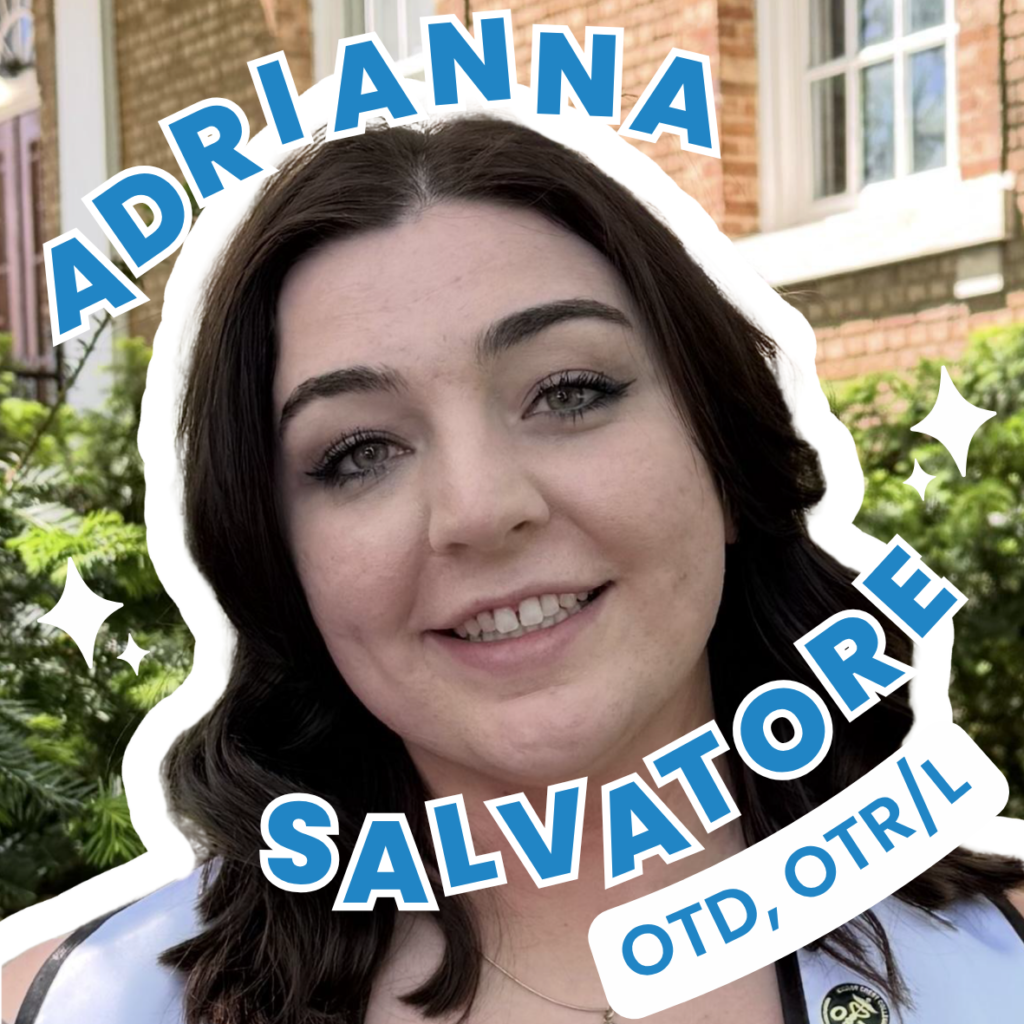
Many parents of little children are considering preschool or kindergarten this time of year. While this is a nerve-wracking yet exciting time for all parents, this can be even more true for parents of children with Autism. We met with Dr. Adrianna Salvatore, an Occupational Therapist here at ACP, who shared her insight on school-readiness from an OT perspective.
Dr. Salvatore has experience with a wide range of ages and skill levels. She is committed to enhancing children’s independence and growth in fine and gross motor skills, motor planning and self-help skills through a client-centered approach and collaboration with team members and caregivers. She is passionate about sensory integration techniques to help children improve skills and self-regulation for participation in daily activities! Keep reading further to learn more.
Meet Dr. Salvatore!
Tell us about yourself.
My name is Addy. I’m an [Occupational Therapist (OT)] here at ACP. I just graduated last May with my doctorate in Occupational Therapy, and I’ve been working here as an OT starting in December. I started off working as a BT for a couple months before transitioning into OT, so that was fun.
Can you tell us a little bit about what you do within your role here at ACP?
As an OT, I help clients work on tasks and skills to become more independent in areas that they need to do or want to do in their daily lives. Improved independence with honestly anything.
School Readiness!
Does your role influence a child’s readiness for preschool or kindergarten and if so, how?
Yes, so OTs here at ACP, we work on a combination of different skills for children to successfully participate and succeed in the school systems. The school system can be very overwhelming. It’s a big change, a lot of new transitions and environments.
So OTs work on those school readiness skills as we do interventions through sensory-based and play-based activity. We work on a lot of things like executive functioning and self-regulation, which is like organization skills, following instructions, managing emotions in school, and self-care.
What is executive functioning?
Executive functioning is a series of skills such as planning, focusing and memory to engage in everyday tasks and activities
Again looking at preschool prep, we work on a lot of skills to function independently in the school system, like use the bathroom, clothing management, like pulling up and down pants, putting your jacket on at the end of the day, putting your backpack on, and also self-feeding. So, working on the ability to open containers, open snack bags, use utensils to successfully participate in like lunchtime, snack times in the classrooms.
We help children understand their sensory needs. We can do that through creating a sensory diet, self-regulation techniques.
What is a sensory diet?
A sensory diet is an individualized sensory program. So we might trial some sensory components with the kids. It might be auditory, like hearing, visual, tactile, deep pressure, like a whole bunch of things. And then we can implement those if the children are having difficulty regulating their bodies or having difficulty with sensory processing from the environment.
What are some things that a preschool or primary teacher could do to help make their classroom more accessible and more comfortable for students that are coming in?
I really love this question. The first thing that comes to mind is try to collaborate with school-based OTs to see what suggestions they may have. That can just be at the individual kid level or it can be for the whole classroom.
I have some experience with my clinical rotations in a school-based setting, and I really love trying to get the whole classroom involved. It promotes that inclusivity for the children.
If a couple of children are a little bit sensory dysregulated, just having a hard time, maybe the teacher can collaborate with OT and come up with whole classroom activities, whether it’s 5 minutes just to move our bodies or 5 minutes to calm down or just different sensory approaches.
Also having an area with accessible sensory tools or calm down tools that children can go to when they are feeling upset, dysregulated, any of those hard feelings.
What are things we can do in our society to help create a more equitable space for people with Autism?
The first thing that comes to mind is definitely to have a better understanding by challenging stereotypes.
I think it’s important to remember that not every individual that has Autism has the same difficulties. Everyone is so different.
We all have diverse strengths, skills, communication needs. I think that’s very important to keep in mind.
Looking at workplace environments, trying to improve accessibility in public spaces, expand employment opportunities, and creating workplace supports for individuals with Autism.
And, just including individuals with Autism in general. Allow them to make decisions. They can understand you, and even if that’s through different ways than what neurotypical people are used to, they still understand you and it really gives them better autonomy and independence in their lives.
Occupational Therapy at ACP!
Can you tell us examples of goals you work on regularly?
I have so many different goals. It’s such a huge range. Goals are definitely age dependent. Some of my older kids that have a little bit more sensory processing needs or maybe just need some more awareness of their body, I have a lot of proprioceptive goals like improving body awareness, spatial awareness …
I have a lot of fine motor goals, so working on hand strengthening and hand manipulation skills to be able to properly grasp things, turn things in their hands, which translate to opening containers, opening packages, playing with toys successfully and independently … I work on scissors skills. I do also a lot of bathrooming skills, so clothing management, washing hands, brushing teeth. I could go on and on and on. I just have so many different goals that we can work on. [Smiles]
Can you tell us more about what body awareness means from the OT perspective?
Sometimes the children I work with will go to sit on a chair and miss the chair or just frequently bump into things. It may come across looking a little clumsy. So, I work on increasing that awareness, like where a body is in relation to the chair. Or, sometimes it’s how hard or gentle we have to use toys or play with materials. Things like that.
What are some of the things that you do in order to accomplish those goals?
I do a lot of research on different interventions. I like to be educated and up-to-date on new things I can try with my clients and also maybe it gives me a better understanding of what I can do with my clients during the sessions to help better improve those goals.
I’m constantly changing like my interventions, just being flexible. I’ll have something planned and sometimes it just does not work. I always have like two or three backup plans.
I feel like also working with kids, it’s different than working with an adult I would assume. Obviously I don’t work in a clinical role, but if you’re working with an adult, it’s like, Okay, do this.
But you’re working with a child. It’s like, What do you want to do? Then we’ll adapt, and we’ll accomplish your goal however we need to accomplish it today.
How do you determine what sort of skills you’re going to work on?
I determine the skills and I’m going to work with my clients based on their interest and needs, and then also skills in areas they may have some difficulty completing independently. I also really like to look at their strengths, as well. I think that’s an important thing as a clinician.
Sometimes when we do assessments, it obviously shows areas where they have difficulty with, but incorporating and highlighting their strengths helps with those skills that they have difficulty with.
And, based on assessment scores and what is seen in the assessment, there’s a whole range of factors we might work on—even when it comes down to routines that they do with their family. Caregivers may be like, Hey, we would love for them to participate in family meal times. There’s like a whole range of like aspects and environments that make me determine what skills I work on with them.
A lot of the kids you work with are very young and have Autism. How do those factors influence your work compared to other Occupational Therapy settings?
I love this question. [Smiles] OT is so different in every setting, and you really have to adapt and be flexible. In this setting, I think about communication approaches. Sometimes in different settings, you can have verbal communication.
Our clients can understand and follow directions, but we have to learn how the children communicate, whether it’s through incorporating AAC devices, gestural cues, visual supports.
And also, building trust in the relationship, as well, and making this a safe environment during OT. Sometimes we work on skills that are very hard, and it can be upsetting and frustrating. Just building that support and knowing that we’re there to support them, even if they are completing a hard task. And then being flexible, like I said, I’ll plan sessions and sometimes they just don’t go like planned … Adapting interventions just to support their strengths and challenges during OT sessions.
There are times where I will be working on very similar goals with two different clients, and it’s completely different OT sessions. So just being mindful that just because it worked for this one kid does not mean that it’s going to work for that other kid, too.
ACP’s OTs primarily work with children aged 2 to 6 years, so we quite often address skills or goals related to preschool or kindergarten settings. Things like organization skills, following instructions, using the bathroom independently, putting on clothing like a jacket or backpack, and self-feeding can make a huge difference for children in the school setting where they often have less one-to-one support.
If you think your child might benefit from Occupational Therapy or if you’d like to discuss school-readiness more, connect with us today to discuss how we might be able to support. Give us a call at 800-679-3609 or complete this form to inquire about services available near you!
You can also meet Dr. Salvatore and the rest of Team OT by exploring our Occupational Therapy page on our website!
Thank you, Dr. Salvatore, for giving us insight on how OT can help prepare a young child for preschool or kindergarten!