
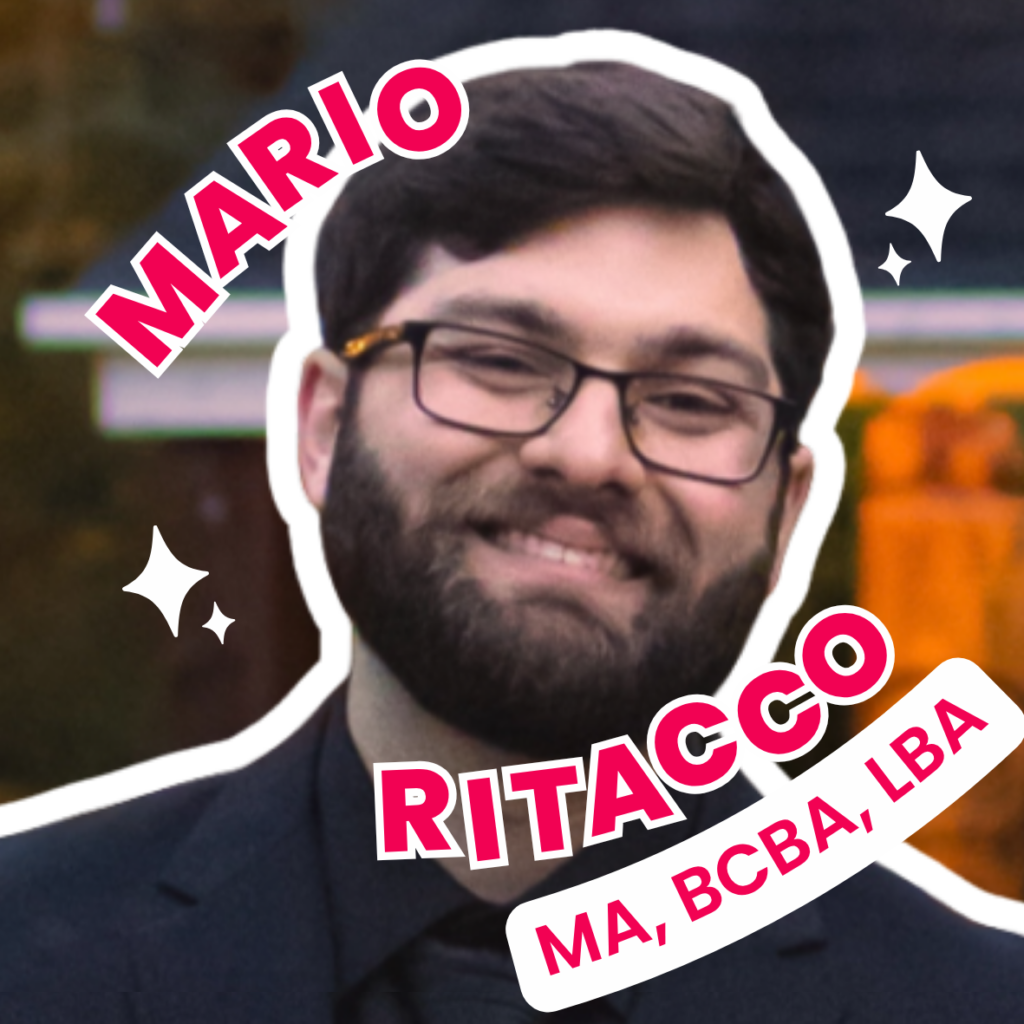
Mario Ritacco, MA, BCBA, LBA on Team Warwick shares his transformation as a Behavior Technician still finding his way, just knowing that he wanted to help people, to Senior BCBA, serving as a trainer and major supporter of our learners and newer teammates. Mario is passionate about making a difference, especially for children who have bigger challenges.
Mario’s approach to leadership is one of understanding. He’s grown with ACP and knows what it feels like to be new and unsure of the future. We know you’ll love hearing from Mario about his experience and what keeps him going!
Tell us about yourself.
I’m a Senior BCBA in Warwick, RI. I’ve been here for about seven years. I’m a pretty big nerd. Honestly, you name something, I’m either into it or like something adjacent to it. So playing video games, Sonic the Hedgehog, Pokémon, Magic the Gathering, all that. I’m obsessed with my cat. I just bought a hat that says, I have a cat at home that loves me very much and is expecting me home soon. I plan on wearing that as much as possible. [Smiles]
Why do you do this work?
I knew I wanted to help people.
I started here as a Behavior Technician. I had a lot of support from Nicole Geca and Lauren Hanson. They were like, Hey, you’re doing a really nice job at this. Keep going. That motivated me to continue with what I was doing.
In my position specifically, I didn’t think I’d like it as much, but I like teaching new people things. I know a lot more than I give myself credit for. That’s always nice to know, like, Okay, I do know what I’m talking about. [Smiles]
At the end of the day, really, I just knew I wanted to help people and this job makes me just so happy. They’re kids. I like a lot of the same things as them. [Smiles] And, the kids seem to like me, so I’ll take that!
Is this what you thought you would be doing or did you kind of consider anything else?
Definitely not what I thought I’d be doing. I didn’t interact with kids until this job. I always thought maybe a School Psychologist. I thought I wanted to do suicide prevention, but I don’t think I was built for that.
Tell us a little bit about your journey to become a BCBA.
I was here and a lot of people were signing up for grad school. I don’t want to say Lauren Hanson and Nicole Geca pressured me into it, but they said, Hey, a lot of people are doing this. I think you should do it, too. And that was it. I said, Okay, sure. Whatever you need. At that point, I was like, I will do whatever Lauren tells me to do. [Laughs] Not in a follow orders kind of way, but in a I’m inspired by you way. I saw what Lauren did all the time. I wanted to do that, too. I just took the leap of like, You guys trust me to do this. I trust your judgment. Let’s do it!
What does a BCBA do at ACP?
There’s a lot of treatment planning, reports, and assessments and all that, which is not my favorite part of what I do. I’m not going to lie. [Smiles] But it’s important. But really, we have a lot of support to give. Whether it’s the staff or the kids or just being present, I think that’s the biggest thing.
We’re always here in the center to provide support. If someone’s walkie-ing for me, even if it’s the 30th time, I’m going. I’m showing up because they need help, and I’m here to help them. It’s the same thing with kids, right? I have a lot of more maladaptive behavior kids. I like feeling needed in that way, selfishly. I’m doing whatever I think is going to work and just providing that behavior support, the teaching support, and trying to help as many people become RBTs as possible.
The support piece is the biggest piece for me, because I’ve been in situations where I didn’t have a lot of support. I’ve been in situations where I’ve had a ton of support, like Nicole always provided support when I asked for it. I’m trying to pay that forward and lead by example. I learned from the best possible person … how to react to things, how to not react to things. At the end of the day, I’d say support is my biggest task in many facets.
Have you ever had an A-Ha moment where you knew you had made the right career choice?
Shortly after I started, one of the kids I was working with most sessions with him turned into an A-Ha moment of, Okay, I’m doing the right thing and I’m where I want to be. His behaviors were really challenging, but we worked with him when I first started until December of 2022, about three years.
Anytime we figured something out for him it was like, Okay, I’m doing something right. He’s responding. I’m doing something that’s working for him, and we’re getting done what we need to get done. Seeing all the things that he is doing now and the things that we helped he and his family do … We got to take him trick-or-treating, which they’d never done before, and it was just a fun experience. Now, they’re out doing Special Olympics and all these things.
What does the future hold for a child with Autism?
There’s a lot of opportunity out there. Especially now compared to maybe 10 years ago. We’re seeing so much more opportunity in community engagement. I think about Love on the Spectrum. Having something like that out there shows what the opportunities are. There are the different levels, right? You’re not going to see everybody in that kind of situation, but it’s an opportunity for a lot of people.
Schools are changing. You’re seeing kids volunteer for unified sports and things like that. There are more options and more people are willing to put themselves out there. I think it depends on how much support is put in, but I don’t think that anybody’s necessarily limited by an Autism diagnosis in the way that people would have said maybe 10 or 15 years ago.
How do you help influence the newest generation of Behavior Technicians?
I try to say, I’ve been here. I know what you’re going through.
I jokingly try to pressure all of them into being a BCBA. [Laughs] I have had a couple people say, Hey, I really think I want to do this. I try to influence the same way that Nicole and Lauren influenced me. Like, You guys are doing really well. You don’t have to continue, but it’d be great if you did. I think you’d be really good at it.
On the hard days, what helps recenter you?
Knowing that I’m going to sit on the couch. I’m going to watch TV, and our cat’s going to come hang out with us. I’m just going to hang out for the rest of the night. And then get back and do it all over again.
What song are you adding to our playlist?
I’m going to choose Sometimes You’re the Hammer. Sometimes You’re the Nail by A Day to Remember. A lot of A Day to Remember songs came to mind, but it’s a great song. The bridge really does something to me at the end. It’s just an emotional part of the song. The album means a lot to me in general. They’re my favorite band. The song title itself resonates with. Sometimes that’s how it goes in the day. Sometimes you’re doing great, you’re hitting everything the way you’re supposed to. Sometimes you just can’t win. It’s just a hard day. You just move along, and you do it all over again.
Want to learn more about the amazing folks on Team Warwick? Navigate to https://autismcarepartners.com/locations/rhode-island/warwick/ meet the team, take a virtual tour, and learn more about our ABA, Speech, Occupational, and Feeding Therapy efforts for the little ones in Warwick, RI!
Warwick, RI is also home to our Psychological Assessment Center, where we currently offer Diagnostic Assessments for a variety of clinical presentations for individuals 18 months to 30 years old. If your child meets criteria for Autism Spectrum Disorder, they may be eligible for services at one of our centers. If eligible, our team will support you in the transition to therapy services. Learn more at https://autismcarepartners.com/locations/rhode-island/warwick-assessment/ today!