Learn about self-help skills with Team South Burlington’s Clinical Director, Kimberly Maki, M.Ed., BCBA, LBA!
Self-help skills, also known as adaptive or daily living skills, are functional skills that allow an individual to manage their daily needs independently.
It is important that these skills are not overlooked when developing a comprehensive treatment plan.
Self-help skills are vital to promoting independence and autonomy, enhancing quality of life, building self-esteem, and supporting social inclusion.
There are numerous self-help skills that we engage in on a daily basis including toothbrushing, bathing, dressing, and toileting to name a few. For most of us, these are probably second nature. But imagine that you did not yet have the repertoire of skills to complete one of these tasks.
How overwhelming and frustrating!
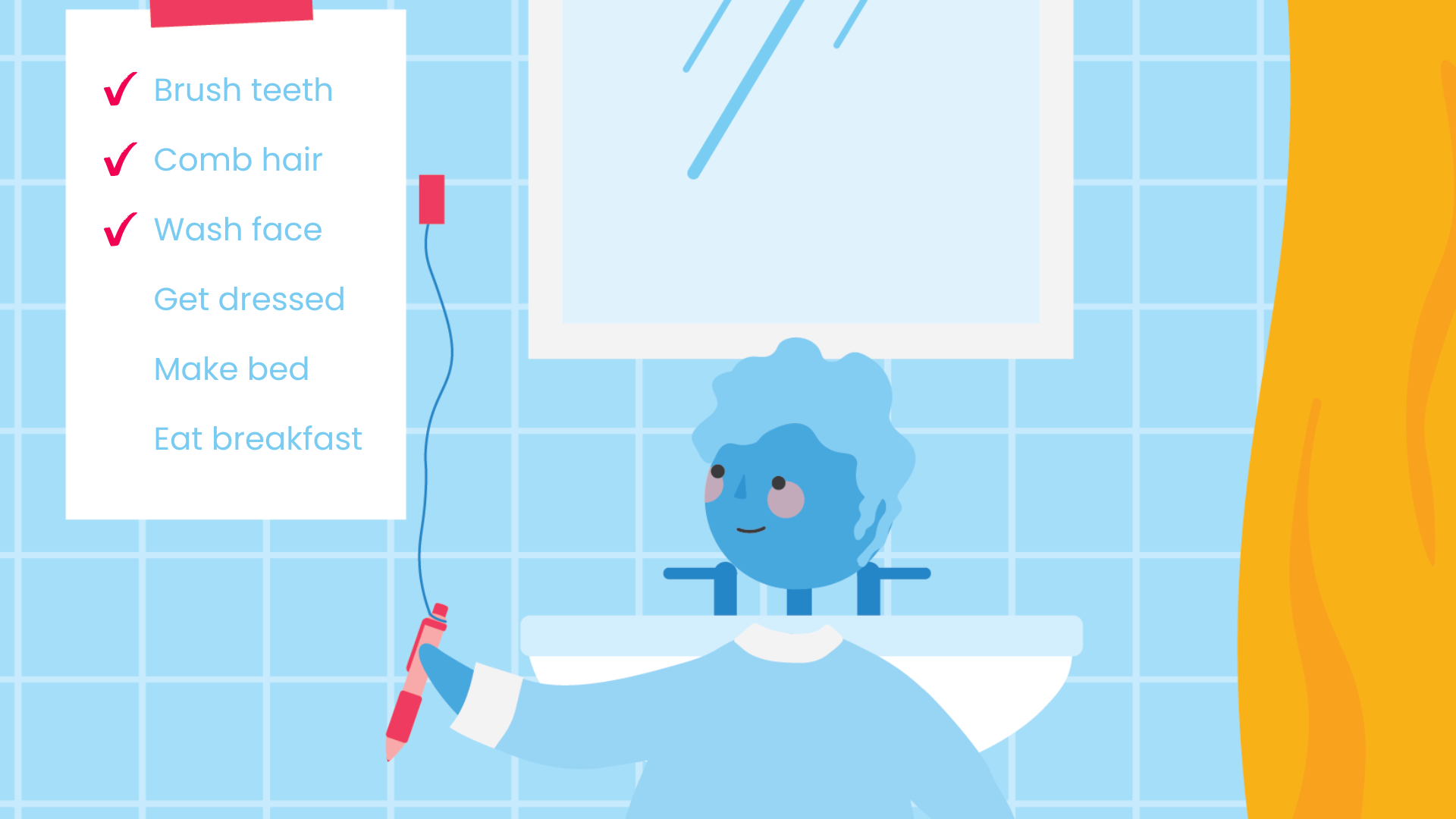
It is important to work with your BCBA to prioritize targeting self-help skills that are developmentally appropriate and meaningful for your child. Your BCBA will likely write up a task analysis to teach each of the identified skills. A task analysis breaks down a larger task (e.g. brushing teeth) into each individual step it takes to complete the task. For brushing teeth, this may start like: (1) walks to sink, (2) picks up toothbrush, (3) turns on water, (4) wets toothbrush, etc.
A task analysis can be taught using forward chaining (teaching the first step first); backward chaining (teaching the last step first); or total task presentation (teaching each step in the sequence from start to finish).
Task analysis is an effective teaching methodology because it makes teaching complex behaviors more manageable and allows for more efficient skill acquisition.
It also allows for precise measurement and analysis of performance on each individual step. Task analysis can be highly individualized and take into account a child’s strengths and areas where they may need more support. Lastly, a good task analysis supports independence. Learners feel empowered to take on a task that could otherwise seem overwhelming.
Let’s help our little learners become self-help superheroes!
Interested in learning more? Connect with ACP’s team of dedicated professionals today! Consider Team South Burlington on Kimball Ave in South Burlington, VT! Connect with us at 800-679-3609 or complete this form to inquire about services available near you!
Not in South Burlington? That’s no problem. Explore all of ACP’s locations here!
You can also explore our beautiful South Burlington center on YouTube!