
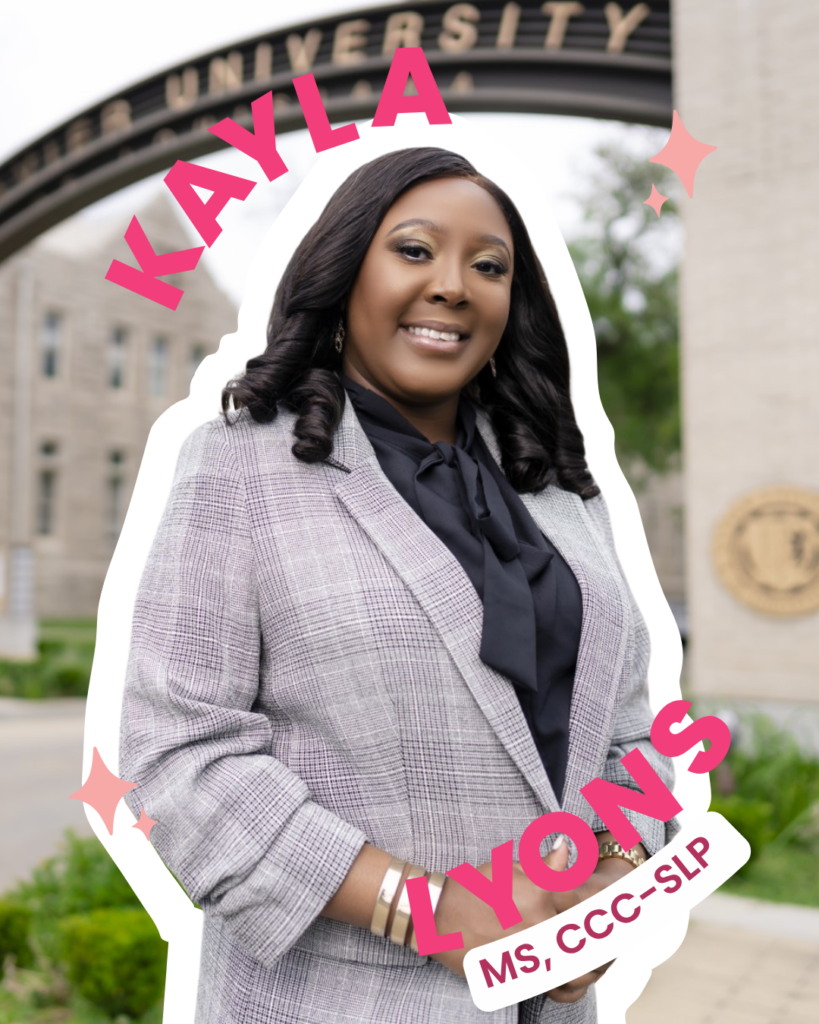
ACP had the pleasure of welcoming Kayla Lyons to our team of life-changing Speech-Language Pathologists in December 2025. Kayla provides Speech Therapy to our centers in Taunton and Auburn, MA, and Amherst, NH. As she tackles this new role, we discussed how she performs Speech Therapy virtually and how her work contributes to overall positivity and mental health for Mental Health Awareness Month.
We know you’ll find her as passionate and interesting as we do!
Have you always been interested in this kind of profession?
I’ve always had a passion for helping others, but I did not start off as a Speech Therapist. In college, my major was actually nursing. My whole life, basically from high school on, I thought that I wanted to be a nurse. I made it all the way to my junior year and decided that I did not want to do it anymore. So, I started researching different careers and my college did have a Speech Pathology program. So, I switched, and I loved it, and I’ve been in the field ever since. I love working with the kids and I love just seeing their growth and just watching their communication skills grow throughout our time together.
Can you tell us more about delivering Speech Therapy remotely?
It is totally different from being in person. It’s still very much functional, but I rely heavily on my Behavioral Therapists in the centers. We collaborate a lot throughout the session. I would not be able to do a session without them. They keep the kids grounded. I do give them different strategies.
With my complex communicators, we do a lot of play-based activities. Those are my AAC users, my non-vocal kids. So, I just coach the Behavioral Therapist throughout the session on different things to do. A session may look like I’m seeing something in the room and I’m like, “Oh, go get that down off the shelf and let’s try that.” Or, I might do something random, like say, “Hey, put a fruit on top of your head,” and just model it for them. At the same time, I’m teaching following directions and prepositions. So, I rely on them heavily.

And for my higher communicators, I have different interactive activities on my screen for them, especially for my children with articulation difficulties. I just target their speech sounds through different activities. And I love when those kids come into the session, they’re immediately telling me, “I want this game” or “I want this, I want that.” And I’m like, “Okay, I’m honoring it. You told me that’s what you want, so hey, we’re doing it.” I just try to make the sessions go as smoothly as possible. I don’t try to make them do anything hard. Ultimately, we’re just trying to work on functional communication. So, I just want it to be fun. I don’t want the kids to feel like it’s work, and there’s something that they have to do. We follow the kids’ lead majority of the time.
May is Mental Health Awareness Month, can you tell us how your work as an SLP ties into that.
The whole purpose of us is to support language. We focus on self-advocacy skills. When you can’t communicate, you get frustrated and that causes anxiety, which will cause negative mental health, I believe. So, I just imagine if I can’t communicate, how would I feel? We teach the kids emotions. We try to reduce stress. We just teach them. We provide more functional communication so that they can express how they feel. We want them to be seen. We want them to be heard and valued.
We want to improve social skills as well. We don’t want them to feel isolated from their family and peers. So, we just want to build their confidence and provide all of the communication needs that they need. I may target things on their AAC device, gestures, spoken communication, anything that we can do to help them communicate effectively. If that’s what it takes. That’s what we do.
Also, when you communicate, that reduces those behaviors that we see a lot of the time in the kids. I just look at it as I would be frustrated if I can’t communicate, which will cause me to have a meltdown and affect my mental health. So, I try my best to help my kiddos communicate effectively.
For my AAC user kids, we teach them requesting and protesting things. We want you, again, to self-advocate for yourself. So, in the sessions, we model that device constantly. “What do you want? Are you all done? Or do you want more?” Things like that. It takes a lot of routine-based things. The center has to be routine. We have to be on routines, and we all have to model, especially in the home setting, as well. We all have to be on the same accord to help them, so that our kid could have a great quality of life. We just all have to model the language in a way for them.
How do you collaborate with families to create that positive home environment that contributes to their growth and communication?
In the centers here, I attend parent training meetings when the BCBAs are on with the parents. I just make them feel comfortable. I ask them questions, they ask me questions. We all just have one goal in mind and it’s to help our kiddo succeed and communicate. Anything that they want from me, going back to my AAC users, if they want things added to their device, I’m happy to add that, and we can start modeling that word. I know a parent asked me to add something to her kid’s device, and it was a preferred item. I think it was a Pop-Tart. And that was just a preferred item that the kid liked, so I added it for her, and she’s been going to the device and pressing it.
I just want the parents to feel like I’m here to help, as well. I just want all of us to work together, and I’m happy to provide any strategies, and also do parent coaching, as well. And what we do in the sessions, I let the parents know that that’s what we’re working on. Either I do or the BTs do. It’s just all one collaboration; a big, beautiful collaborative thing.
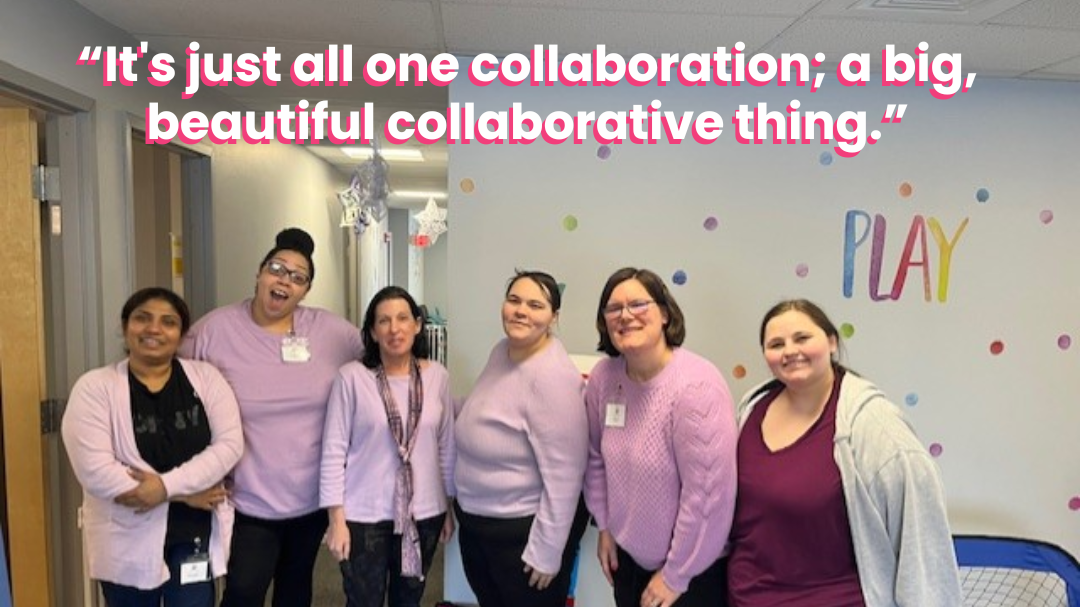
And I give the BTs the skills to target, so they reinforce and implement throughout the day. So again, with those kids who are working on requesting, they help them request, and they use their communication boards and AAC device throughout the day. They do heavy modeling. What I’ve added to the device, they model and just reinforce.
Like I said, I need the centers. I wouldn’t function remotely without the centers. They’re all just a helping hand. They print materials out for me for sessions to have for my kids who have any liketangible things that doesn’t do well with the screen, those kids. and basically I teach [the BTs] what I would do in the session if I was there in person, those play-based skills. And then we also feed off each other. I’m on the communication side, they’re more on the behavior side. So they teach me things on behavior, and I also let them know, like, “I may ask you to do something if the kid is not feeling it, please let me know. And you can do what you feel is best.” So, we support each other.
Can you tell a story about how you’ve seen our services significantly impact the quality of a child’s life?

I would say recently in one of my centers, I have been teaching one of my kiddos requesting and protesting. In this session, we were doing an activity that wasn’t her preferred choice. So after a while, I think she just got done with me and her BT. She went to her device independently and told us, all done. And then proceeded to get up from the table and walk to the door. And I’m like, “Okay, you told me you were all done. You advocated for yourself that you were all done. I’m fine with that. Let’s go do something else.” So, I was really happy she did that. And her mom also said she wanted a preferred item at home one day. And she went in her backpack and just found her device and told her parents what she wanted. And I was like, “Oh my God, I’m so happy that she’s actually just going to her device and just advocating for herself!” So, I was really happy.
ACP is incredibly fortunate to have team members like Kayla delivering Speech Therapy to our kiddos. By prioritizing collaboration in order to offer Speech remotely, Kayla is helping us take strides in making our services even more accessible. While Kayla serves Taunton and Auburn, MA, and Amherst, NH, we also offer Speech Therapy at other centers depending on their location! To learn more, visit our Speech Therapy services page and explore what we have to offer.