If you’ve had the chance to connect with Kara Morrison-Smith, ACP’s Assistant Vice President of VIS and Partnerships, you know what it’s like to have a conversation with someone truly passionate about equity and access. During the following discussion there were multiple instances where there were chills running down our arms as she shared her story, her why, and what keeps her motivated to keep moving forward. Hear for yourself:
Tell us more about yourself.
I grew up in the middle of nowhere in New Hampshire. A lovely rural place. It had a lumberyard and one blinking yellow light. After I graduated high school, I went to college at Bentley, which is Bentley University. Now, at the time it was Bentley College. I thought I wanted to be a systems analyst, because I really liked computers.
And as it turns out, I do really like computers. That’s still true, but I don’t really like the business environment of solely computers, and I’m not all that excellent at complicated math. [Laughs] So, in my freshman year of college, I had a panic moment, and this panic moment may come for individuals later in life, but it occurred for me at age 19. And my panic moment was, what am I contributing to the world by becoming a systems analyst? And in a 19-year-old’s brain, that was enough for me to consider a change in projected career path.
Now I know that I’m leaning on people to do that analytical work and it still ties in, but that’s what resulted in the change for me, and I did a transfer to Ithaca College right into the Speech-Language Pathology program.
And I learned more about Speech Pathology as I went. It wasn’t what I thought it was, but that’s how I made my way into Augmentative and Alternative Communication. And there’s the computer tie in we were waiting for. I maintain that and from there I went to Monarch Center for Autism in Cleveland, OH, and I was drawn to that program because of the type of learners that tend to be there and the model that they used. That’s where I learned the elements of the Visual Immersion System.
And I met my wife, Chevaun, when I was out there. And when she finished her PhD, we moved home to New England for me, my home. And I ended up at a school that was similar in structure to the school I was at in Cleveland, in that the learners’ needs were very intense and the language deficits were severe or profound.
It hurt me that everyone did not know the research that I had become so very familiar with when I was in Cleveland. And I wanted to be a part of spreading that research, and that’s how I ended up in this role today.
Tell us a little bit about how you’ve seen things evolve from your perspective.
At Autism Care Partners, the first evolution that was very, very important to occur was to ensure some individuals, even just some, understood what the Visual Immersion System was and how it could have an impact. That in a new organization can be tricky because a one-size-fits-all should never be an approach in therapy. What’s important is that’s not what the VIS is.
Second of all, we always as therapists want to be mindful of something that one adheres to without kind of questioning. So, for instance, one approach can be good. It doesn’t mean that that’s all we should know and learn about. What’s different about the VIS is that it takes the knowledge that somebody already has and then we can overlay the VIS onto it. It’s in tandem with and that’s not how everything works. So, it took some time to build that understanding. It takes time to kind of build those pieces so that people can see what the VIS is and that was important factor #1.
Important factor #2 was we have some people who understand the VIS. That’s excellent. Now we need people to understand that there is both a clinical reason to know that we should be using this framework and a business reason, because we need to balance both. And the reality is we are doing therapy to such a higher caliber that there is a business benefit to it, as well. So that was endeavor 2.
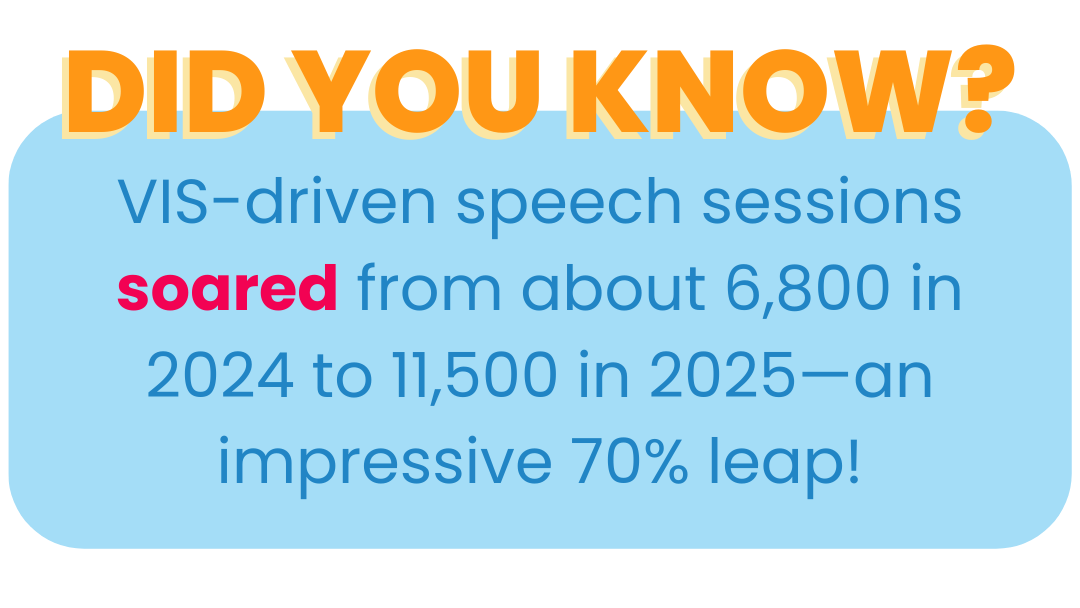
And then endeavor 3 is that exponential growth across disciplines, across sites. And in 2025 we’ve really, really dug into that and I’m very, very excited to have made it there. We’ve expanded to the Occupational Therapy department, and they have become champions of the VIS. Not just, you know, Yes, we were trained on it. The end. But Emily Sliwowski, our Director of Occupational Therapy, truly understands the benefit and looks to problem solve with tools knowing the reason that they should be implemented. Having more leaders in Autism Care Partners who see those components … Jill D’Angelo of course already has that as our Director of Speech-Language Pathology. But now we have it in other disciplines and then we’re building it and building it. Some great collaboration with Elizabeth Bland in 2025 building our training through the lens of a BCBA, so that when we train on the VIS, the principles are there of what the VIS is. It’s specific to the discipline of ABA.
From your perspective, why does the VIS logo roll-out matter so much?
I have learned from our marketing team what the impact of marketing can be, and marketing is not my forte, and I gladly lean on individuals who are much better at other things than myself. We can’t be good at everything, and that’s just fine with me. I willingly acknowledge my deficits. [Laughs] And it is a deficit area for me in terms of understanding all of those pieces to make something successful.
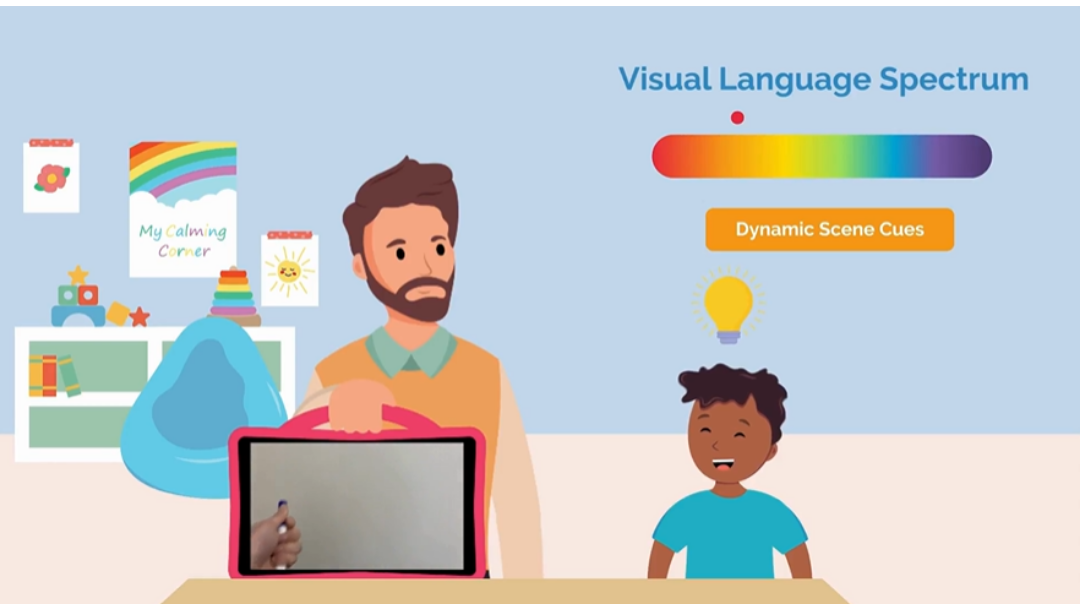
But I do know that marketing is a component—understanding the best way to do it, not my forte—but I strongly value that marketing must be applied. And when we think of marketing, and we think of branding and we think of the VIS, it wasn’t there. It wasn’t there. The best way that we had to refer to the Visual Immersion System was something that we refer to as the visual language spectrum, and it’s something that I use throughout my trainings.
That that was it. There was no like, Oh yes, the VIS I think of … or this draws to mind … or I recognize that because it’s the VIS. And the VIS is very, very complex when we think of what it entails for language and communication. And that’s why we have to lean on our Speech-Language Pathology so much. Because they are the language experts when it comes to seeing all of these different tools and strategies that anyone is doing and not being able to visually wrap that into something recognizable. It was a large hole that I owe gratitude to ACP’s marketing team for filling because we need it. We need a way for other people to recognize Oh yeah, that’s the VIS. VIS, I’ve heard about that, seen that. And it wasn’t there. Even though all of these tools have been researched, there was nothing tying it together in a way that other people knew.

How have you seen the VIS really transform your clinical work?
I had a learner come in and sit on my lap in a Speech Therapy session. And I took my arms, and I put them around him. He grabbed his talker and said seat belt. What is great about that is for this individual learner, I knew that he was imagining a seat belt. And imagination and pretend play is a huge, huge piece when we think of language and how it needs to develop.
Then he took his talker, and I let my arms go, and he took his talker, and he said seat belt tighten. I have literally never worked on the word tighten in my life, but that is what this learner said. So, I wrap my arms around him again. And I left them there. And then do you know what he did next? He said, seat belt—I kid you not—loosen. And I opened my arms and took them off. And that type of language, that novel … I did not come up with that activity. I did not explicitly teach those language forms. But what did I teach him? I taught him things like agent-action. What was the agent? It was the seat belt. What was the action? It was tighten. It was loosen. So, when I did that, he was applying the semantic relationships that we work on all the time to something that was novel. I never … It was not a sit down, memorize this activity. He just said it to me. And then he said seat belt finished. Seat belt finished!
So, when we think of that progress for learners, when we’re thinking of language, our goal is always for it to become novel and generative and to be guided by typical language development. And I’ve worked with this particular learner for quite some time, and to know that that is truly what we’re achieving just gives such weight to the work that we’re doing.